

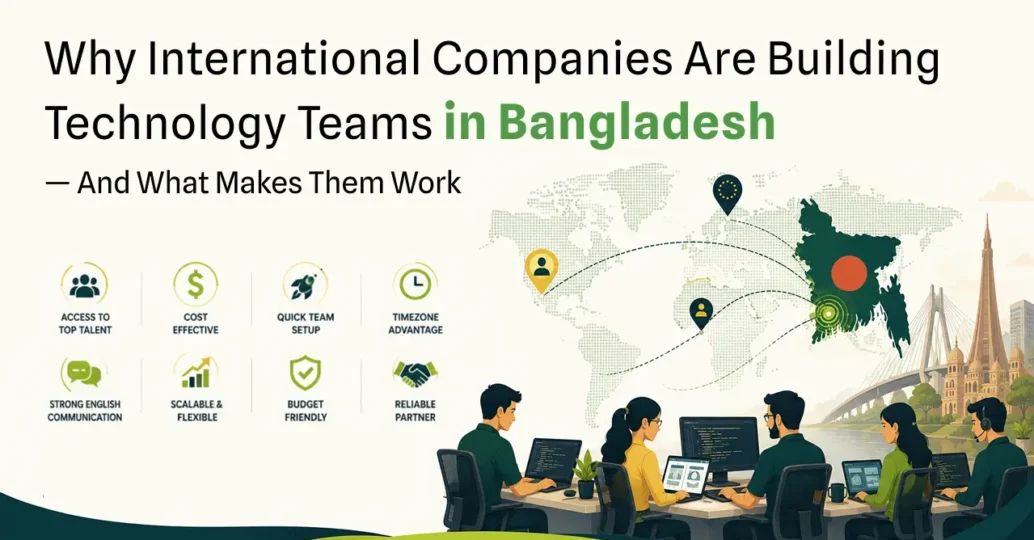
Why International Companies Are Building Technology Teams in Bangladesh — And What Makes Them Work
Building a technology team in another country can look straightforward from the outside:
In reality, it is rarely that simple.
- 1. Find developers
- 2. Set up communication channels
- 3. Start executing projects
The difficult part isn’t only finding good people. It is building a team that understands the business, communicates effectively with international stakeholders, delivers consistently, and can grow as the organization expands.
I learned this through direct experience, not theory.
Over the years, I have had the opportunity to build and manage dedicated technology teams in Bangladesh for both European and North American founders, while working closely with international offices, clients, and executive management teams.
That experience has shaped the way I look at Bangladesh as a technology delivery destination.
Why Bangladesh?
There are several practical reasons why international companies are actively considering Bangladesh for dedicated technology teams.
1. Access to Full-Spectrum Technology Talent
Bangladesh has a rapidly growing pool of software professionals across many core disciplines:
- Engineering: Frontend, Backend, Mobile (iOS/Android), and Full-Stack Development
- Quality & Operations: QA Automation, Manual Testing, DevOps, and Infrastructure
- Design & Strategy: UI/UX Design, Product Design, and Technical Architecture
- Leadership & Operations: Project Management, Technical Leadership, HR, and Administration
For companies looking to scale, this talent density provides the flexibility to design a custom structure around actual business requirements rather than rigid roles.
2. Strategic Cost Efficiency
Cost is certainly one of the main attractions. A Bangladesh-based team can often be established at a significantly lower operating cost than an equivalent team in Western markets.
However, low cost should never be the primary driver.
The real value emerges when cost efficiency is paired with:
Good Talent + Strong Leadership + Clear Processes + Reliable DeliverySaving money while sacrificing quality isn’t a cost-saving measure—it’s a bad business decision.
3. Faster Execution Than Starting From Zero
Hiring individual engineers across multiple disciplines separately is a lengthy, resource-draining process.
If you need a Team Lead, several senior engineers, QA specialists, DevOps support, and UI/UX capability, recruiting everyone individually in competitive Western markets can take months.
Leveraging a local technology leadership structure solves this bottleneck. The goal isn’t simply to recruit headcount—the goal is to establish a functional, delivery-ready team from day one.
Managing a 25+ Member Dedicated Team: Practical Lessons
One of the most significant milestones in my career was managing a dedicated technology operation of more than 25 professionals in Bangladesh for a European founder.
This was a physical, dedicated office setup encompassing specialists across technical leadership, senior engineering, UI/UX, QA, DevOps, project management, and operational HR.
My responsibility went well beyond basic tech management. I was directly involved in coordinating the Bangladesh operations with the company’s Dubai office, international leadership, and global client stakeholders. The wider ecosystem included an international team of over 12 people across multiple locations.
That experience taught me three fundamental truths about running large-scale distributed operations:
1. Managing People Is Different From Managing a Project
When you have a team of five, you can manage day-to-day work through direct communication. When a team grows beyond 20 people, that informal approach breaks down rapidly. You need explicit structure.
We implemented quarterly OKRs (Objectives and Key Results) and KPIs, aligning individual responsibilities directly with project requirements, delivery timelines, and business forecasts.
This established a transparent flow:
Business Objectives -> Project Requirements -> Team Responsibilities -> Individual PerformanceThis framework allowed us to identify resource bottlenecks and potential delivery risks weeks before they could impact clients.
2. High-Volume Delivery Demands Delivery Discipline
At peak capacity, the Bangladesh operation was delivering approximately 20 eCommerce projects per month for European clients.
When multiple complex projects move simultaneously, managing technology is no longer just about writing clean code. It requires strict discipline across:
- Technical coordination and architecture reviews
- Resource allocation and capacity planning
- Rigorous Quality Assurance (QA) standards
- Transparent client communication and status tracking
- Structured performance management
3. Operational Models Must Fit the Market
I later managed a separate dedicated team of 8 professionals focused on supporting North American clients across Web Development, Custom Web Applications, and UI/UX Design.
While the team size was smaller, the underlying principles remained unchanged: Clear ownership, transparent communication, explicit expectations, and full accountability.
This reinforced an essential principle: There is no single “ideal” team size.
- A startup might need 4–5 core engineers.
- A growing agency might need 8–10 specialists.
- A scaling product company might require 20+ dedicated professionals.
The team structure must always be built around business requirements, not an arbitrary headcount target.
Overcoming Distance: Time Zones and English Communication
Time Zones as a Strategic Advantage
Time-zone differences are often cited as a challenge. With the right operating model, they become an advantage.
- For European organizations: Bangladesh offers useful working-hour overlap, enabling real-time collaboration during core business hours.
- For North American organizations: Teams can be structured around deliberate overlapping schedules, structured end-of-day handovers, and clear asynchronous workflows.
The key to asynchronous success is having established systems for documentation, escalation protocols, meeting cadence, and delivery tracking.
English Communication Is Non-Negotiable
Technical skills get a project started; clear communication keeps it moving.
Distributed technology teams need professionals who can communicate complex ideas directly with founders, product managers, clients, and designers. Clear communication becomes vital when project requirements evolve, urgent decisions are required, or delivery roadblocks appear.
What I Would Tell an International Founder
If you are considering building a technology team in Bangladesh, do not start by asking:
“How cheaply can I hire developers?”
Instead, start with these strategic questions:
- What are we actually trying to build?
- What technical and operational capabilities do we need?
- Who will lead the team locally?
- How will performance and quality be measured?
- How will this team integrate with our existing organizational culture?
- Who takes ownership when a delivery issue arises?
These questions matter far more than comparing developer salary tables. A low-cost team lacking experienced leadership becomes expensive very quickly.
The Model That Works: An Extension of Your Business
The most successful offshore delivery model is not an adversarial vendor relationship:
International Company vs. Outsourced Vendor
It is a unified operational model:
International Company + Local Technology Team
Your team in Bangladesh should thoroughly understand your:
- Product vision & customer profiles
- Immediate business priorities & long-term technology roadmap
- Quality expectations & delivery standards
- Organizational culture & core values
When a team operates with this level of alignment, it ceases to be an external software resource—it becomes a genuine extension of your organization.
Where This Model Delivers Maximum Value
A dedicated technology operation in Bangladesh is uniquely suited for:
- European Founders: Seeking high-performing engineering capacity with strong working-hour overlap.
- North American Companies: Looking to expand engineering velocity without incurring astronomical domestic hiring costs.
- Digital & Tech Agencies: Requiring a dedicated, dependable engineering arm to back project delivery.
- SaaS & Product Companies: Needing to scale product feature development predictably.
- Early to Mid-Stage Startups: Wanting to preserve runway while maintaining complete technical quality.
The Real Advantage Is Leadership
Bangladesh offers exceptional technical talent, clear cost advantages, and a thriving technology ecosystem. But talent and cost efficiency alone do not guarantee a successful international operation.
Leadership is the bridge that connects talent to business outcomes.
You need leadership on the ground that understands founder expectations, translates business goals into practical execution plans, enforces accountability, manages performance, and solves operational challenges proactively.
That is where local technology leadership transforms an offshore initiative from a risky venture into a scalable strategic asset.
Let’s Connect
Are you an international founder, agency leader, or product executive looking to build or scale a technology team in Bangladesh?
Whether you are designing a new team structure or optimizing an existing operation, I am always open to discussing tech leadership, delivery strategies, and operational growth.